Saturday, December 02, 2017

I Probably Need Some Coffee


really don't have anything particular in mind to write about right now, but I need to write because I'm anxious and I need an outlet to channel my anxiety. Okay, I really don't have to tell you that but at this point I'm just typing without really putting any thought to it, so bear with me.

I realize that, hey, this blog is dead and nobody would give a damn about what I say anyway, so I should've been able to write freely. I, however, couldn't help but think that I've been so terribly self-centered all this time and I have failed to relate to what's going on around me, to the world around me, to the people and their stories. Well, I still do sit back and watch people like a creep (not literally, mind you) and wonder if they were struggling with something or such, but all this time I've been completely out of touch with what makes me human.

Now that I look back and evaluate, I apparently have been spending too much time being out of the circle, the box, whatever shape you think humanity is. I tried to watch, to be the neutral party, to be the observer, but I completely forgot my place as a fellow human. It's not that I was acting God though; in fact, I stooped too low to even catch the view. I am really just embodying the worst kind of observer you'll ever meet.

And when I live that way, I cannot help but put myself on edge. All the time. You see, the more I think about it, the more I realize that I've been doing life wrong. If normality is a spectrum, I constantly move from one edge to the other. It never really ends because I haven't found my gravity. I am still wondering what would keep me down and let me stand still, when everyone around me has started rotating along the course of the universe.

So what have I been doing all this time? Probably the best answer I could come up with is to be the random figures in someone else's story, to be that one person in the crowd you would completely forget in five minutes. The background, never the detail. At least that's how I feel but, seriously, when is feeling ever rational? I need to start using my head more.

Okay, I really do need some coffee.

Friday, October 20, 2017

I Just Need to Get These Out of My System


I wonder how I even got here, to this point. As a child, I always felt different. In a bad way. I felt like I was always missing something but I couldn't tell what it was or whether I truly was missing it. Was I even normal? What was it like to be normal?

I wonder how people do what they do. Why can't I do it the way they do? With ease, with optimism so high it's almost innocent. What is it you're seeing that I'm not? The world is just a wide spectrum of colors. Do you see the world in black and white? Is that why life seems so simple?

What about me? What about people who see all things gray? What about people who seek neutrality, people who stand in between heaven and hell, people who observe the war rather than fight in it?

No wonder I bask under fantasies, where the world doesn't need to be so vast, where complexity deconstructs itself, where poets are glorified and evils keep their heads down in shame.

Where do I even find the ears that listen? Words make sense when you allow it to do so. Whispers are screams that need a gentle touch of encouragement. All streams to a certain end. But where? Where would mine go?

All these nonsense I call poetry. No longer they give me a sense of safety. Not that they ever did. Now I'm angry and I'm yelling at the distance. Now I'm scared. The vastness of the universe struck me. There are oceans unexplored, star systems unreachable. Stars, galaxies dying billion years ago and we look up directly at their memoirs.

I don't have the right to whine, do I?

Tuesday, April 04, 2017

Feeling Words


I want to write well. I've always thought that I had my way with words and that writing was my forte but there always seems to be something missing, especially when it comes to fiction; as if all I could tell was a bland plot with zero emotional impact. It feels empty and it frustrates me to no end, partly because I thought I'd be able to communicate better through writing.

Let me give you a hint to this particular problem I've been facing and simultaneously experimenting on:
Today, for the third time this week, I woke up feeling disoriented.
Sounds boring, doesn't it? What about this one?
Today, for the third time this week, I woke up as if my head was anywhere but attached to my body. I failed to explain the rapid beating of my heart either for the unshakable feeling that I was not supposed to be there, wherever I was, was faster to sink in. I grasped the gentle surface beneath me and chuckled out of disbelief of how ridiculous I had been for someone who was simply lying on my very own bed, covered in my very own blanket.
Can you feel my words? Did my message reach you? Was it clear enough? These are the questions that I often face whenever I try to write. I am currently learning to write fiction properly and I found that many amazing authors are in fact amazing due to their ability to convey a certain feeling through their words in such relatable, though not always accurate, and engaging ways. 

How did they do that? To find the answer, I did a small exploration on feelings and how writers utilize them. I thought it might be useful for basically anyone who is trying to write or simply loves to read.

Let's talk about feelings first. Earlier I mentioned something about feeling disoriented. Being disoriented is not a feeling you can easily describe for it is a complicated vagueness. When a person says that he feels disoriented, according to the dictionary, we may assume that he is so confused he loses all sense of direction. That, however, isn't the only way to describe the feeling. We can also assume that his body doesn't seem to cooperate with him, or that he simply has a hangover—all descriptions that do not simply form a conclusion.

The same goes to other feelings that may seem to have a solid explanation like happiness or sadness. How do you explain happiness? Happiness is the feeling of being so lightweight you forget everything bad that has ever happened in your life. Happiness is when you see small feet taking wobbly steps followed with occasional thuds and giggles. Happiness is not being able to control your creepy love-struck teenager grin because you are bursting with emotions inside. It's when satisfaction, bliss, joy and perhaps pride meet in the middle. Somehow it's rather easy to pinpoint when someone is happy but is that it?

My point is: there is no simple way to explain even such 'basic' feeling like happiness.

Feelings are complex matters. If I had to choose one adjective to describe feelings, I'd choose rich. Each feeling seem to have their own degrees of intensity. On top of that, I think feelings do not simply consist of a single emotion wired on your body. You cannot simply be angry. When a person gets angry, there is always a hint of something else on it. It can be frustration, disappointment, or even sadness. You cannot simply be sad, either. Along with sadness may come regrets, longing, and even a happy tinge. That's why the word 'bittersweet' works.

Thus, it only makes sense that people have so many ways to convey it. When you feel something, you may want to talk about it with whoever the hell sitting next to you, write it down and make it slightly more dramatic (not that being dramatic is wrong because your feelings are valid no matter how people see it), do spontaneous acts like a big fat hug that crushes one's bones, or simply let your biological reaction take over. Perhaps you'd cry or have a cardiac arrest or something.

When I thought about it, the first question that came to mind was whether I could associate feelings with senses. I thought that maybe I'd dig a little about how writers used a certain sense or maybe all five to convey feelings.

We are gifted with at the very least five senses: sight, hearing, taste, smell, touch. Less than five still counts as perfect too. All these senses are the basic tools we use to comprehend life and tell what's going on around us. These five senses can bring you feelings—the tears that roll down when you see the opening scene from Up, the 'I love you's that bring you down to your knees, the surprisingly familiar taste of home in the Chinese takeout you bought, that perfume you specifically hate because your annoying boss at work wears one, the gentle fur of your old golden retriever. 

Senses are the bridges to feelings, and what I understand is that amazing writers cleverly use them as a two-way bridge instead of a one-way lane of brain receptor, in the most discreet way possible. I notice that when these writers describe something, they don't actually give you the whole picture. Instead, they leave traces for your senses to relate and let their readers put their personal meaning along to what these writers intended to say.

Take a look at this excerpt from George R.R. Martin's A Clash of Kings:
Tyrion watched his niece kneel before the High Septon to receive his blessing on her voyage. Sunlight caught in his crystal crown and spilled rainbows across Myrcella's upturned face. The noise from the riverside made it impossible to hear the prayers. He hoped the gods had sharper ears. The High Septon was as fat as a house, and more pompous and long of wind than even Pycelle. "Enough old man, make an end to it," Tyrion thought irritably. "The gods have better things to do than listen to you, and so do I."Martin, 1999:589.
This is one example which pretty much explains why I enjoy A Song of Ice and Fire saga. This paragraph in specific was written in a way that would bring you, the reader, into the picture instead of being a mere observer, despite being told in third person. Notice how Martin used the sense of sight and hearing as a bridge to connect the readers into the scene of Myrcella's departure from King's Landing and almost effortlessly put them in Tyrion's shoes. By the end of the paragraph, you can feel how much Tyrion hated to be there.

When you use senses and put feelings to your words, the whole story becomes so alive that people attach themselves to it. Feelings bait your imagination and ease your thirst for connection. When you finish the book, a part of you dies with it because all this time you've been living on that story.

That, ladies and gentlemen, is the kind of writing I aspire to do.

Sunday, March 19, 2017

Let's Think About God (and Basically Everything)


An image of galaxy NGC5408 as a reminder that you're not that special (Credits: NASA/ESA)


I’ve been thinking a lot about God, about the universe, about our existence. Apparently, having a lot of free time is a curse—or is it a gift? I’ve been feeding my hungry mind with some deep shits to the point that I even read an essay on Einstein’s theory of relativity. Never had I expected that there would be a day where physics and I actually get along. I even helped my sister with her chemistry homework. What the hell? Anyway, let’s talk about what I’ve been thinking about lately before my mind wanders off again.

(I have short attention span.)

I spent my time reading about religions and I’ve been thinking that maybe we, the theists, are all praying to the same supreme force after all. Think about it. Our spiritual side has become a legit source of knowledge. Why do you think philosophy flourishes? Our thirst for understanding God and our own existence leads us to religious knowledge, to enlightenment. My point is: some knowledge might actually come from God himself. The system of religion, however, was the creation of humankind. Humans were the one who created rules, who interpreted knowledge into certain norms and values. Every person has their own version of events, however, and if you stretch it further you’d find that religious difference isn’t that much of an issue. It’s all about different results of interpreting things.

It becomes an issue, however, once politics enters the scene. When politics collides with basically anything, nothing is pure anymore. We are dealing with greed for power, with certain interests, with elites. Wars didn’t simply break over difference in faith—religion was simply the outer layer of the case. Now that is a whole different story.

It’s all about perception. Some religions see God as transcendent, as an ultimate force beyond the force of the universe, as the creator of the universe itself. Other religions see God as immanent, as an inseparable force that flows and basically constructs the universe (See Magnis-Suseno, 2006). In the end, God exists and we believe it. It’s just that we are a curious bunch of brains that enjoy living in our own bubble, holding on our own version of reality.

In fact, I found that our religions—the religions we know of in our modern society—aren’t so different after all. The concept of purgatory in Catholicism reminds me of the Hindu's belief in reincarnation. No, they aren't the same but the bottom line is: both see the best in people. Why else would God give you a chance to escape hell and purify your soul? Why else would God let you repent your sins and be a better individual in another life? God is willing to wait for you so you can actually join him in heaven, so you can be one with him again in the universe. Just how sweet is that?

(Anyway, please take it with a grain of salt.)

Thus, it's fine to think that your religion is the best religion—if it suits you best then of course you'd say it's the best—but it is stupid to claim that yours is the only and the most correct one. If there's one thing I learned from years of studying social sciences, it is that an argument cannot be completely true or false. There's always two sides of the coin. There are many sides of the story. Why do you think the word 'multifaceted' is on my top list of vocabulary? Because it makes the most sense. 

That also applies to religions. Whatever you choose to believe or not to believe, you must have your reason. If the reason is valid to you, then it is valid in your reality. It is your truth. Your truth, however, may not be the same as mine.

For you is your religion and for me is mine (Quran 109:6)

In the end, we have no idea what truth the universe actually holds but our longing to understand it, to reach things we cannot see, is what matters. Life's never dull when you think about all the possibilities out there, of what kind of truth actually lies, of what kind of explanation we deserve of life. I honestly cannot wait for the day when all truth uncovers, when we finally get the answers to our existential crisis and questions.

I have too much free time, indeed.


Reference
Magnis-Suseno, F. 2006. Menalar Tuhan. Yogyakarta: Kanisius.

Sunday, January 15, 2017

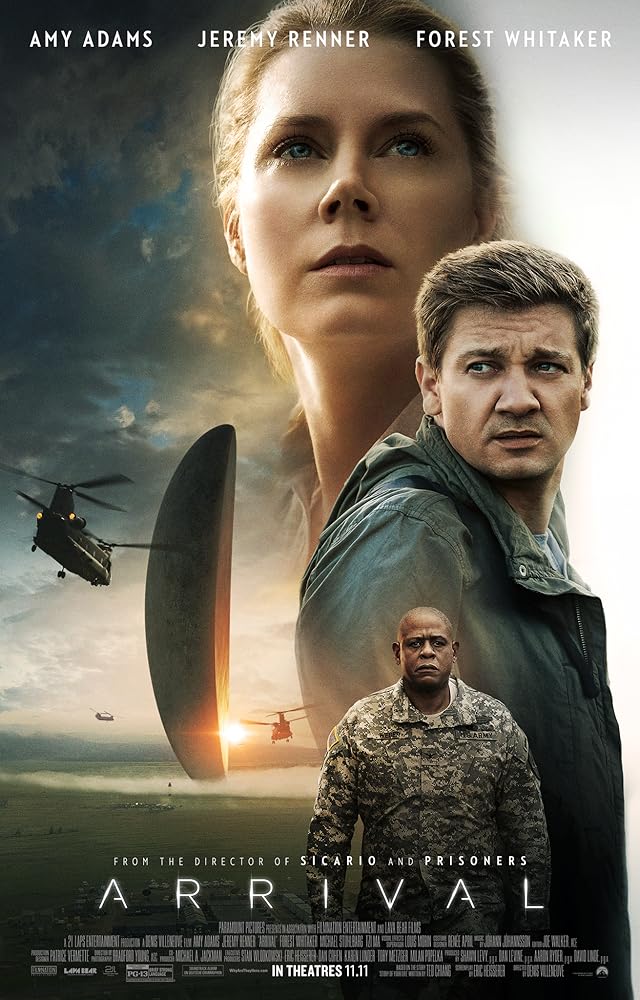
Movie Review: Arrival


Have you ever watched a movie so deep you couldn’t tell if the movie was good or bad? But then you walked out the cinema and went ‘holy shit, that was indeed mind-blowing’ and started having mild existential crisis?

That was probably the first thing I had to say about Arrival. I saw the movie yesterday and, boy, it was definitely not what I expected when I decided to get myself a ticket in the first place. Let me elaborate in the next paragraphs to come.

For the starter, I’d say that Arrival falls in the science fiction/psychological category. Go check their IMDB page for more accurate details.

The story revolves around Louise Banks (Amy Adams); a linguist, a professor, an expert in language and translation field. For the first three minutes or so, they showed us a brief story of Louise’s life as a mother. For the first three minutes or so, I legit thought that I entered the wrong theater (despite my mind yelling ‘but it’s Amy Adams!’) because (1) I wasn’t prepared for such sentimental side, not when I came to the cinema expecting space and aliens (due to its trailer), and (2) that scene alone would fit perfectly on Buzzfeed’s 31 Movies All Mothers Should Watch with Their Daughters list.

I didn’t sign up for that—not that I’m complaining though.

But then, Louise started to talk about how her perspective on time changed and that was exactly when things were getting pretty interesting.

What happened was that one day, twelve gigantic oval rock-like object appeared in twelve different locations around the world including Montana, US. The army came knocking on her door in search for a way to understand what these ‘guests’ were ‘saying’ and, long story short, they brought her to Montana where she’d meet Ian Donelly (Jeremy Renner); a physicist whom she’d be working very closely with. Every 18 hours, the strange object would open its ‘door’ and their task was to go meet the owner (aliens!) and figure out what the hell they were even doing, hanging several feet above the ground for what seemed to be no reason.

In the end, Louise and her team were finally able to decrypt their language. It turns out that these aliens called hexapods (due to the number of what seemed to be their legs) spoke in sentences with a whole different syntax from human language; something they called non-linear orthography for the hexapods used circular symbols which actually consisted of words with no particular sequence. To make it simpler: their sentence had neither beginning nor end.

Let that sink.

Before I spoil the movie even further, I have to say that Arrival might not be everyone’s cup of tea. If you expected to see some ‘time and space’ contents, you’d be pretty disappointed because the movie only explored the ‘time’ part and left out pretty much everything about the ‘space’ one. If you’re looking for some badass action a la Star Wars franchise, boy, you’re watching the wrong movie.

In a way, the movie was pretty anticlimactic because in the end, spoiler alert, the hexapods and their vehicles just literally dispersed into thin air and bid farewell to Earth. The movie failed to answer the basic question that was ‘what the hell were those hexapods and which part of the galaxy did they even come from?’ which might be pretty annoying. The only clue we had about these hexapods was that ‘they’re trying to help and they’ll be back in 3,000 years’ and that basically explained nothing. 

Imagine you’re just chilling and suddenly a stranger comes to ‘help’ you and you’re like ‘uh, who the hell are you and why do I even need help?’ but the stranger only goes ‘you don’t have to know my name’ and disappears like he's some sort of masked hero. That’s how I felt.

I, however, love this movie. The thing is: everything about this movie went against my expectation and beyond but in a good way. I love how the movie digs into deeper question like the way we perceive time or the way we interpret reality. Arrival offers solid philosophical questions, which was enough to cover up the lack of answers we had about the extra-terrestrial part of the movie. This movie's definitely a heaven for postmodernist ideas. It was intriguing—the idea of nonlinear way of thinking—and right now I can’t think of any better quote than the Ninth Doctor’s definition of time:

"People assume that time is a strict progression of cause to effect but actually, from a non-linear, non-subjective viewpoint, it’s more like a big ball of wibbly-wobbly, timey-wimey…stuff."

To sum up, Arrival is an open-ended movie which makes a good prologue for a greater movie but when you leave it alone, it makes you question the way you see life and it’s great nonetheless.

If you're into stories that go beyond what's served and push you deep in thought, then I'll definitely recommend this movie for you.
© Unabridged Nonsense
Maira Gall